
How to Gently Begin a Writing Year (Even in Mid-January)
January has a way of making us feel late before we have really begun.
By the time the second half of the month arrives, the big declarations feel heavy (I will write a NOVEL!) and the energy that carried us into the new year has started to thin. If you are thinking about beginning a writing year and wondering if you have already missed your moment, let’s reframe things.
A writing year does not begin with a dramatic decision or a perfectly designed plan. It begins quietly, often in the middle of ordinary life, when you make a little space for creativity and step into it.
You do not need to quit your job, disappear for a month, or announce anything publicly. You need something much smaller and much more sustainable.
You need time, a place to land, and a few signals that tell your nervous system it is safe to stay.
Start by carving out the time
Most people imagine a writing year as something that requires large, uninterrupted stretches of freedom. In reality, the writing year is built one hour at a time.
Choose an hour you can return to most days, even if it moves occasionally. Early morning before the house wakes up. Late afternoon when your energy dips and you would normally scroll Instagram or TikTok. Evening, when the day has settled and you can sit with a warm drink and no expectations.
This hour does not need to be inspired. It needs to be protected.
Try to think of your writing time as an appointment rather than a mood. You are not asking yourself if you feel like writing. You are not waiting for the muse. You are simply showing up to the space you have made and seeing what is there.
If you have the capacity for two hours, that is a gift. If you have one hour, it is more than enough. Even a half hour practice can be helpful.
Prepare the space
One of the reasons people struggle to stay consistent with writing is decision fatigue. Each day asks too many small questions. Where will I write? What will I use? Do I have everything I need?
Having a prepared writing environent will help you avoid these questions and create a writing habit.
Charge your laptop and your mouse. Open a fresh document and leave it waiting. Place a notebook and pen where you can reach them without searching. Clear the clutter so you have a space you love to inhabit.
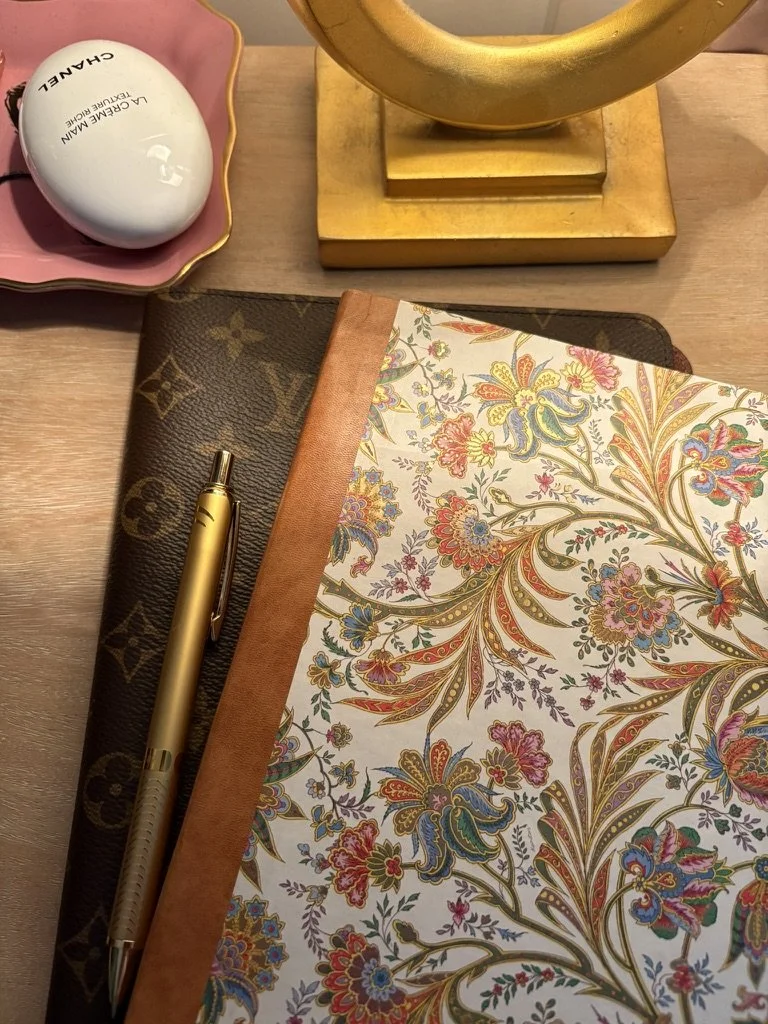
The goal is not to create an entire writing room (that can be a form of procrastination). The goal is to remove friction so that when the hour arrives, you can sit down without distraction.
Create small rituals
Writing asks us to be present with our thoughts and our uncertainty. For many people, that can feel a little scary, particuarly if you are writing a memoir or drawing a lot from your own experience. Small rituals can help signal that this writing practice is not a threat.
Perhaps you have a cup of herbal tea in the same mug each day. Perhaps you have candle you light only when you sit down to write (we love this one). Perhaps you have a familiar playlist that fades into the background.
These are not rewards for finishing or producing something good. They are cues that tell your nervous system that this is a safe place. Do some light box or 4-7-8 breathing to settle your body.
Over time, your body begins to recognize the ritual and settles more quickly. The writing year becomes something you enter rather than something you push through.
Be clear about your commitment
At the beginning of a writing year, it helps to be honest about the real commitment you are making.
You are not committing to pages, chapters, or outcomes. You are committing to showing up. You are committing to staying when the work feels quiet, awkward, or unfinished. You are committing to letting the year unfold without constantly checking for proof that it is working.
Some days you will write sentences you love. Some days you will write notes that go nowhere. Some days you will simply sit with the work and make small adjustments.
All of it counts.
The writing year is not a productivity challenge. It is a relationship. And like any relationship, it deepens through consistency, patience, and care.
***
Whether you are reading this two weeks into January or two weeks into July, and wondering if you have missed the window, you have not. The writing year does not care about calendar dates. It responds to attention.
You can begin today by choosing your hour. By placing the tools within reach. By making a cup of tea and sitting down without demanding anything from yourself.
That is how a writing year begins.
Xx Jen